Computer Vision / Caplogy Innovation
Person detection in overhead fisheye images
A six-view projection pipeline for person detection in distorted, overhead camera images.
- My role
- Final-year project · Computer Vision
- Period
- Feb — Aug 2026
- mAP@50 · Mode B
- 78.6%
- Recall · Mode B
- 87.0%
- FPS · Mode B
- 46.7
Reported validation: Mode B (Gradient Boosting), NVIDIA RTX 5060 8 GB, FP32. Evaluation split: 1,568 composites (15%). Source: PFE report, Part III, tables 1.1–1.2. These figures have not been independently reproduced here.
Inside the system
From lens geometry to detections
Architecture overview based on the report and public pipeline.
- 01
Fisheye image
Overhead input
- 02
Gnomonic views
6 views → 2 × 3 composite
- 03
YOLO26x
One forward pass
- 04
Backprojection
Return to fisheye coordinates
Mode A
Geometric rules · Optuna
Mode B
Learned filtering · Gradient Boosting
| Configuration | mAP@50 | Recall | FPS |
|---|---|---|---|
| A · Optuna | 75.4% | 80.2% | 54.9 |
| B · Gradient Boosting | 78.6% | 87.0% | 46.7 |
Source: PFE report, Part III, table 1.2 (p. 60). RTX 5060 8 GB, FP32; internal validation split. Each row is a distinct configuration.
View an actual prototype diagnostic
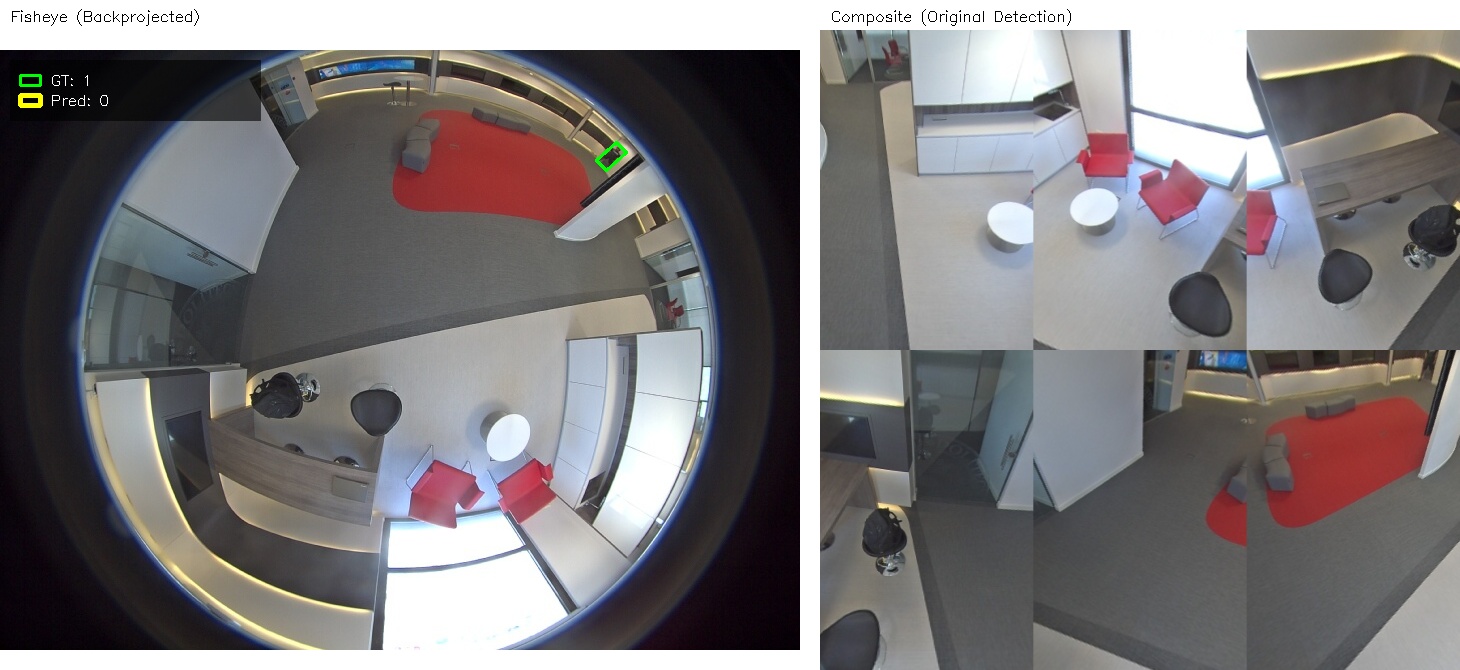
01 / The context
What the project addresses
Overhead fisheye imagery requires a detection pipeline that accounts for strong geometric distortion. This final-year project explored gnomonic projection and post-processing for single-class person detection.
02 / My contribution
What I worked on
Designed the projection and detection pipeline, trained models and evaluated geometric and supervised post-processing approaches.
The challenge
Make people detectable across the fisheye image while handling detections produced by multiple projected views.
03 / The approach
How the pieces fit together
- Project each fisheye image into six views, arranged in a 2 × 3 composite.
- Run single-class detection with YOLO26x.
- Apply NMS-free post-processing using geometric rules and supervised learning, including Gradient Boosting and Optuna optimization.
- Use 125,430 annotations from four public corpora and evaluate detection performance and GPU throughput.
04 / The outcome
What the work delivered
- Compared a geometry-based mode (75.4% mAP@50, 54.9 FPS) with a learned mode (78.6% mAP@50, 46.7 FPS) in the report’s validation setup.
- Prepared 10,450 composites and 125,430 annotations from HABBOF, CEPDOF, PIROPO and WEPDTOF.
- Connected projection, single-pass detection, backprojection and duplicate filtering in one pipeline.